A practical AI workflow design playbook

From Prompt Engineering to Context Engineering

A Playbook for Designing Reliable, Reviewable AI Workflows

PDF download · 328 pages · Revised Edition · October 2026

Better prompts are only the beginning. Move from one-off AI experiments into reusable prompt systems, context packages, source boundaries, evaluation rubrics, human review gates, and governed workflow pilots.

Educational guide and workflow-design materials. Human review remains required. No final regulated professional advice.

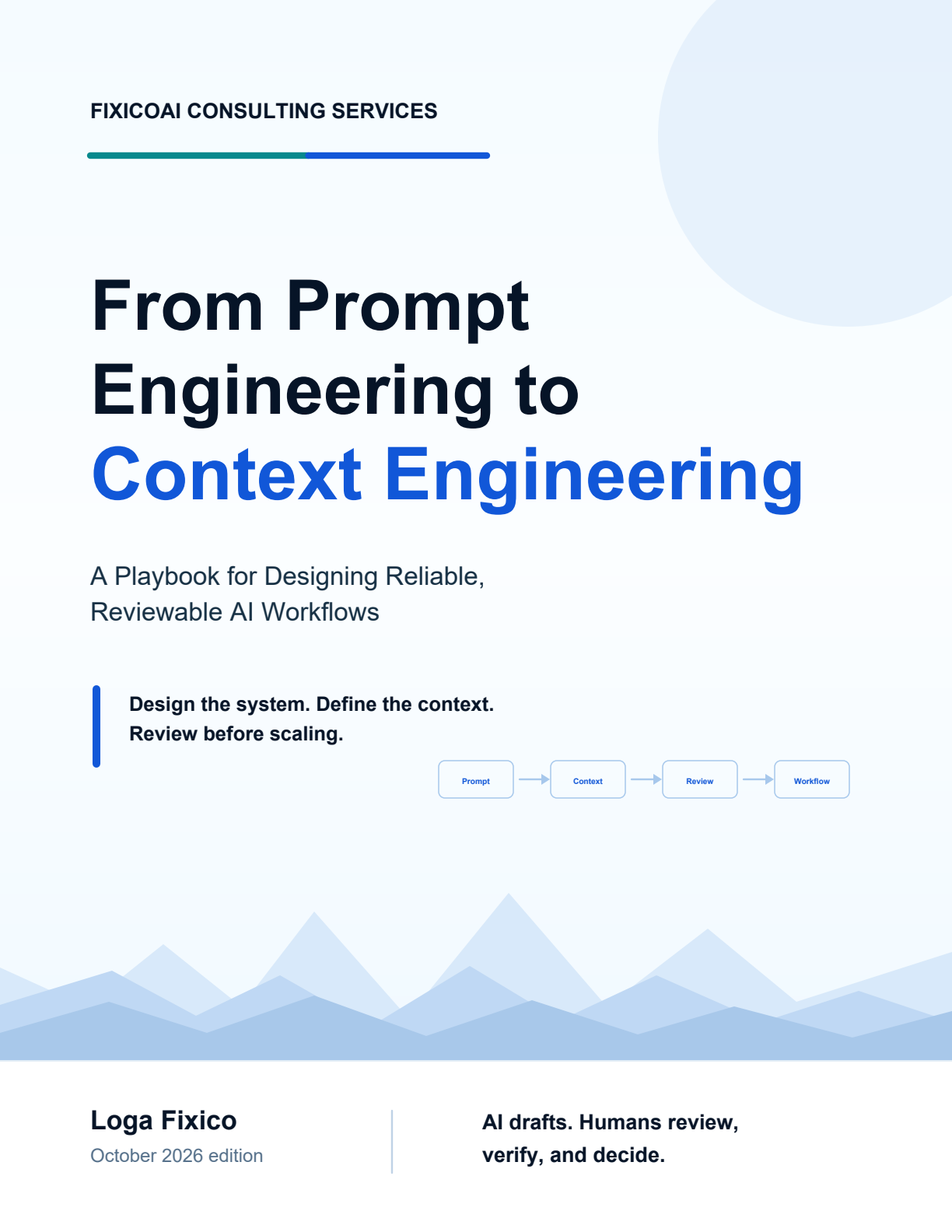
Cover preview for From Prompt Engineering to Context Engineering
From Prompt Engineering to Context Engineering · Loga Fixico

The problem

Give a useful answer a repeatable structure.

A useful answer can still be difficult to repeat safely. Without clear context, source boundaries, review criteria, risk screens, and human approval points, AI output becomes harder to trust and easier to misuse.

Prompt engineering helps you ask better questions. Context engineering helps you design the conditions for better work.

The method

Design the prompt, the context, and the review path.

The goal is not to make AI automatically right. The goal is to make output easier to aim, check, improve, and govern.

  1. 01Prompt system
  2. 02Context package
  3. 03Review gate
  4. 04Governed pilot

Practical outcomes

Learn the method. Leave with working tools.

What you will learn

  • Use the 7-part prompt formula as a practical briefing structure.
  • Move from one-off prompts to reusable prompt systems.
  • Create context packages and define source boundaries.
  • Evaluate outputs with practical rubrics and test cases.
  • Design human-in-the-loop review and approval gates.
  • Plan one governed AI-supported workflow pilot.

What you will build

  • A reusable prompt template with risk and review rules
  • A prompt chain for a multi-step workflow
  • A context package for a source-based task
  • An output evaluation rubric and red-team test set
  • A human review checklist and team prompt standard
  • A governed pilot plan for one AI-supported workflow

Inside the Playbook

Eight parts, 56 chapters, and a practical implementation toolkit.

01

Foundations for Advanced Prompting

Modern prompting, the 7-part formula, risk, reviewability, and the bridge to context engineering.

02

Prompt Design Patterns

Role, task, objective, context, audience, format, guardrails, and instruction hierarchy.

03

Prompt Workflow Architecture

Prompt chains, handoffs, workflow maps, review loops, prompt libraries, and team standards.

04

Professional Prompt Library

40 professional prompt templates for practical work, QA, governance, assistants, and workflow design.

05

Advanced Tool and Retrieval Workflows

Files, sources, context windows, retrieval concepts, assistants, multimodal work, and automation boundaries.

06

Evaluation, QA, and Red-Teaming

Quality rubrics, test cases, failure logs, red-team checks, regression checks, and human review.

07

Governance and Responsible Implementation

Sensitive-data boundaries, high-stakes rules, approval gates, documentation, and pilot readiness.

08

Implementation Toolkit

Worksheets for prompts, context packages, workflow maps, output review, testing, assistants, and governed pilots.
Choose the right path

Start with the level of support you need.

Free starter path

Learn the foundation

Primer, Jumpstart Guide, and Readiness Assessment.

$0

Explore the free path

PDF download · Templates

Prompt Library Starter Pack

25 prompt cards in a 60-page PDF, with input boundaries, review checks and fictional practice tests.

$19 founding price Planned standard $29

Get the Starter Pack

PDF download · 328 pages · Revised Edition · October 2026

Playbook only

For readers who already understand basic prompting.

$39 founding price Planned standard $59

Get the Playbook only

One-time purchases in USD. Applicable taxes are calculated at checkout. Downloads are delivered through Lemon Squeezy. The standard prices shown are planned future prices.

Who it is for

People ready to move beyond one-off prompts.

  • Consultants and trainers
  • Small-team and operations leaders
  • Technical generalists and workflow builders
  • Prompt-library and custom-assistant planners
  • Practical professionals working with non-sensitive examples

Who it is not for

Anyone looking to remove judgment or accountability.

  • Quick prompt hacks with no review process
  • Unsupervised sensitive or customer-impacting automation
  • Final regulated professional advice
  • Permission to bypass workplace policy or data boundaries
  • Guarantees that AI output is automatically correct

Safety and trust

AI can be useful without being automatically correct.

Use AI to draft, summarize, organize, compare, plan, test, and suggest. Humans still approve, decide, verify, and own the result.

For work affecting people, money, rights, safety, compliance, security, public trust, or sensitive information, use AI to support preparation and review—not to make the final decision.

License and responsible use

Use the prompts in your own work.

Individual purchase permits copying and adapting designated Playbook prompts and blank worksheets for your own learning and work, including a private assistant accessible only to you. Ordinary work outputs may be used. Uploading the whole book, redistributing templates, publishing shared assistants containing the material, and model training are excluded. Team, classroom, workshop and client distribution require the corresponding permission or license. See the full purchaser license on page 7.

The Playbook is educational and does not create a professional relationship. Third-party product and platform references are used for identification and education; no affiliation or endorsement is implied.

Common questions

Before you choose the Playbook

Is this just a book of prompts?

No. It includes patterns and examples, but the focus is context packages, source boundaries, review criteria, evaluation, prompt libraries, and governed workflow pilots.

Do I need to be technical?

No. You need to be willing to define the work clearly, protect sensitive information, review outputs, and improve the workflow over time.

Is this for beginners?

It is best for people who understand basic prompting. Beginners can start now with the free Primer; the Handbook is included in the Complete System.

What is context engineering?

It is the practice of designing the information environment around an AI task: what the AI may use, what it must not assume, what needs verification, what the output should look like, and how the work moves through review.

Can teams use it?

An individual purchase does not grant permission to distribute the book or templates to a team. Team, classroom, workshop and client distribution require the corresponding permission or license.

Was AI used to produce the Playbook?

AI tools may have supported drafting, editing, organization, formatting, review, or cleanup. Loga Fixico reviewed, selected, arranged, edited, revised, and approved the final material.

Build the full path

Move from better prompts to reviewable AI workflows.